
Part 2 of From Piggy Bank to Portfolio
By Rachel O’Connor, Certified Financial Planner®
Quick summary: Most parents want the same thing: for their kids to have a better start than they did. Investing early is one of the surest ways to give it, because time does most of the work. This article covers what the money is for, the five main investment types, whose name it goes in, who pays the tax and when your child gets it.
Most parents I talk to have a version of the same wish. A deposit so their daughter isn’t renting at 35. School fees covered without the stress. A son who understands money by the time he leaves home, because nobody taught us.
The good news is that kids have the one thing investors can’t buy: time. A modest amount, invested early and left alone, has decades to grow. The hard part isn’t the amount. It’s knowing where to start.
Why are we investing for our child?
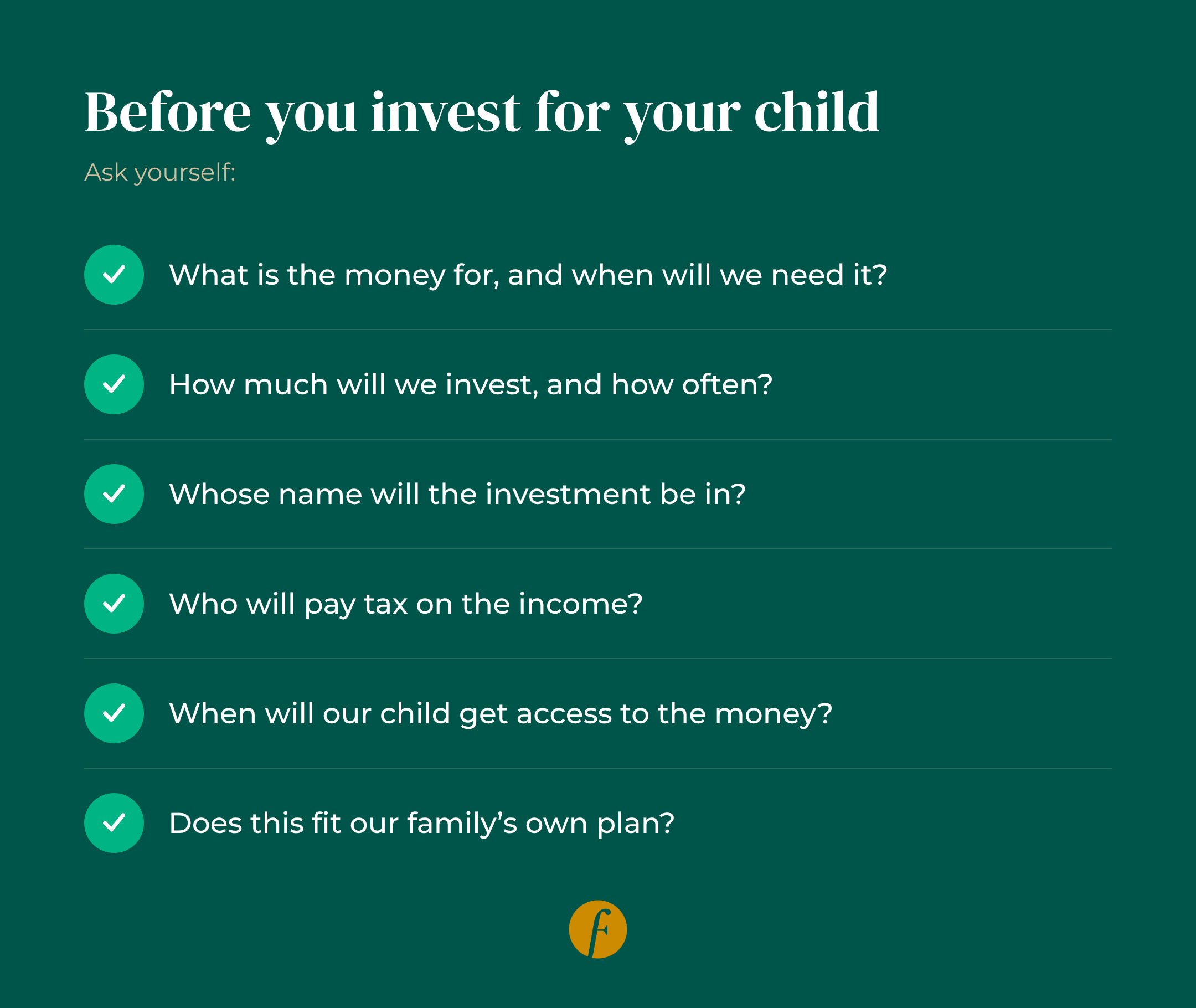
Start here, before you look at a single app or fund. What the money is for decides almost everything else: how long it stays invested, how much risk it can carry, how much you need to put in, and whose name it should be in.
The reasons I hear most:
Education. School fees or university. A known date and a roughly known amount, usually 5 to 15 years away.
A head start on a home. A deposit at 25 or 30. A long horizon and a big target.
Travel, a gap year, a first car. A shorter horizon and a smaller amount.
A nest egg with no fixed purpose. The longest horizon of all, and the one where time does the most work.
Teaching them to invest. The amount matters less than the habit. A few hundred dollars and a statement they can read will do it.
Two things follow from the purpose.
Time. Money you won’t touch for ten years can ride out the ups and downs of the sharemarket. Money you’ll need within three years can’t, and belongs in a high-interest savings account.
Amount. Work backwards from the goal. $100 a month for 15 years is $18,000 of contributions, and with growth it could be a good deal more. Then be honest about what you can keep up. Regular and modest beats ambitious and abandoned.
Write it down. “We’re putting in $100 a month so Mia has a deposit to put towards a home at 25” is a plan. “We should probably invest something for the kids” is a wish.
What are the different types of investments?
Where I name a platform or provider, it’s an example to help you research, not a recommendation. Flourix Wealth doesn’t endorse any of them, and the right fit depends on your family’s circumstances.
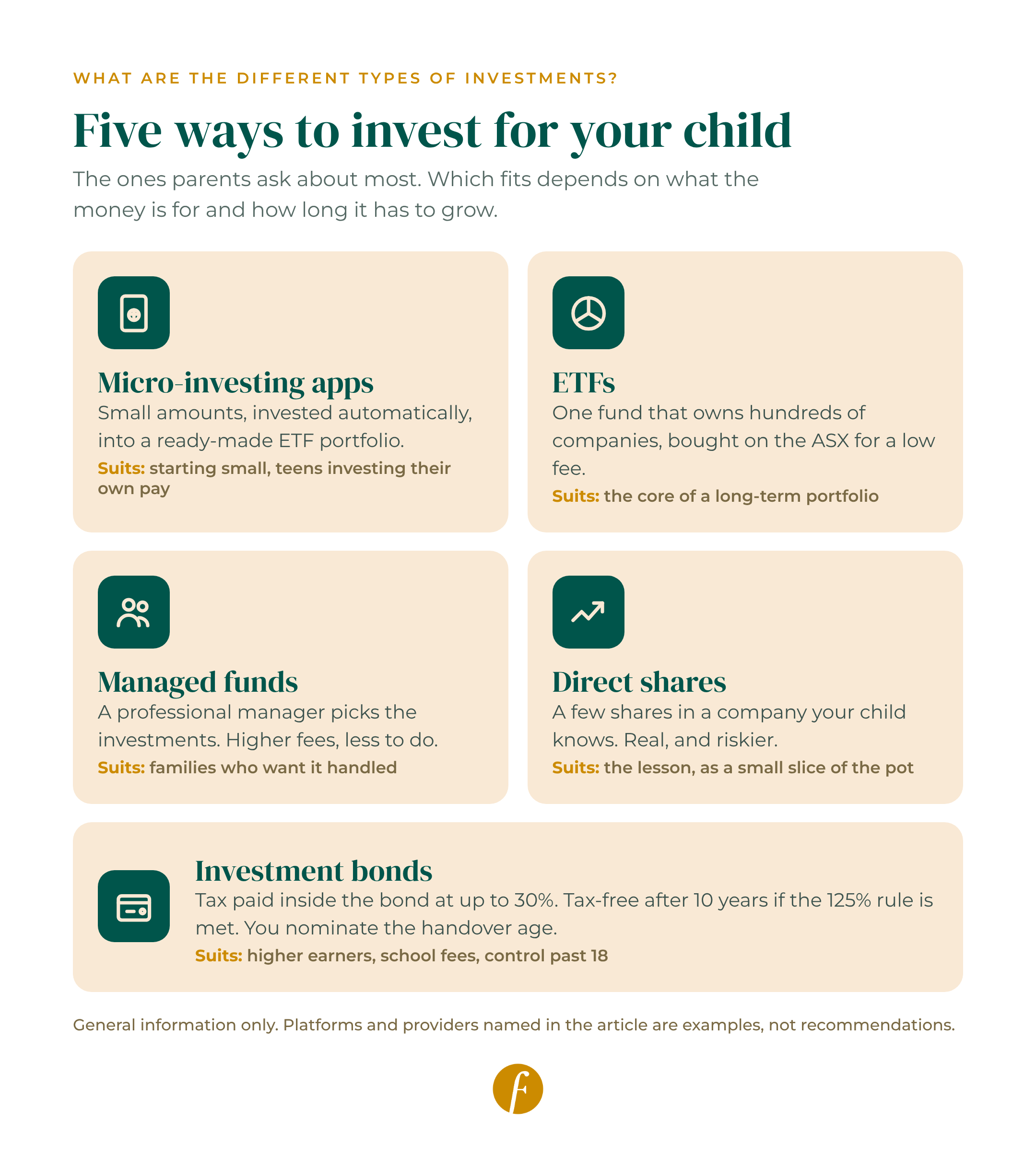
Micro-investing apps
Apps that invest small amounts automatically, such as round-ups from everyday purchases or a set $10 a week, into a ready-made portfolio of ETFs. Examples include Raiz, Spaceship and Sharesies. Some offer kids’ accounts, held by a parent until the child turns 18.
Suits: starting small, making the balance visible, and teenagers investing part of their own pay.
Watch for: a fixed monthly fee can be a big percentage of a small balance. Check the fee before you check the returns.
ETFs (exchange traded funds)
One fund that owns hundreds of companies, bought and sold on the ASX like a single share. You can choose Australian shares, global shares or a mix, for a very low fee. Buy them through an online broker. Several brokers, including CommSec, Superhero and Pearler, offer accounts for minors held by a parent.
Suits: most families, as the core of a long-term portfolio. Easy to explain to a child: you own a tiny slice of lots of businesses.
Watch for: the price moves with the market. This is a five-year-plus investment, not a savings account.
Managed funds
A professional manager picks and manages the investments, and you buy units in the fund directly or through an investment platform. Vanguard Personal Investor, for example, offers a kids’ account.
Suits: families who want it handled, and regular contribution plans.
Watch for: fees are usually higher than an ETF, and some funds have minimum investments of $500 or more.
Direct shares
Owning individual companies. A few shares in a business your child knows, the supermarket, the bank or the airline, makes investing real in a way a fund never will.
Suits: the lesson. Pick one or two together and talk about why the price moved.
Watch for: one company is far riskier than hundreds. Keep direct shares a small slice of the pot, not the whole thing.
Investment bonds
A managed investment with a tax twist. The provider pays tax on the earnings inside the bond at up to 30%, so nothing goes on your tax return or your child’s. Hold it for 10 years and keep each year’s contributions within 125% of the year before, and you can withdraw the lot with no personal tax to pay. Most let you nominate the age your child takes it over. Examples include Generation Life, Australian Unity and Futurity.
Suits: higher-income parents, school fees on a known timeline, and families who want control to run past 18.
Watch for: fees vary a lot between providers, and if your marginal tax rate is below 30% your own name may cost you less. Break the 125% rule or miss a year and the 10-year clock restarts.
Should the investment be in my name or theirs?
Whatever you buy, it has to sit in someone’s name. That decision matters more than the choice of investment, because it decides who pays the tax and when your child gets access, and it’s the hardest thing to change later.
One rule first: nobody under 18 can hold shares, ETFs or a managed fund in their own name, because a minor can’t sign a binding contract. Every “kids” account, whatever the app calls it, is held by a parent until the child turns 18.
That leaves four choices.
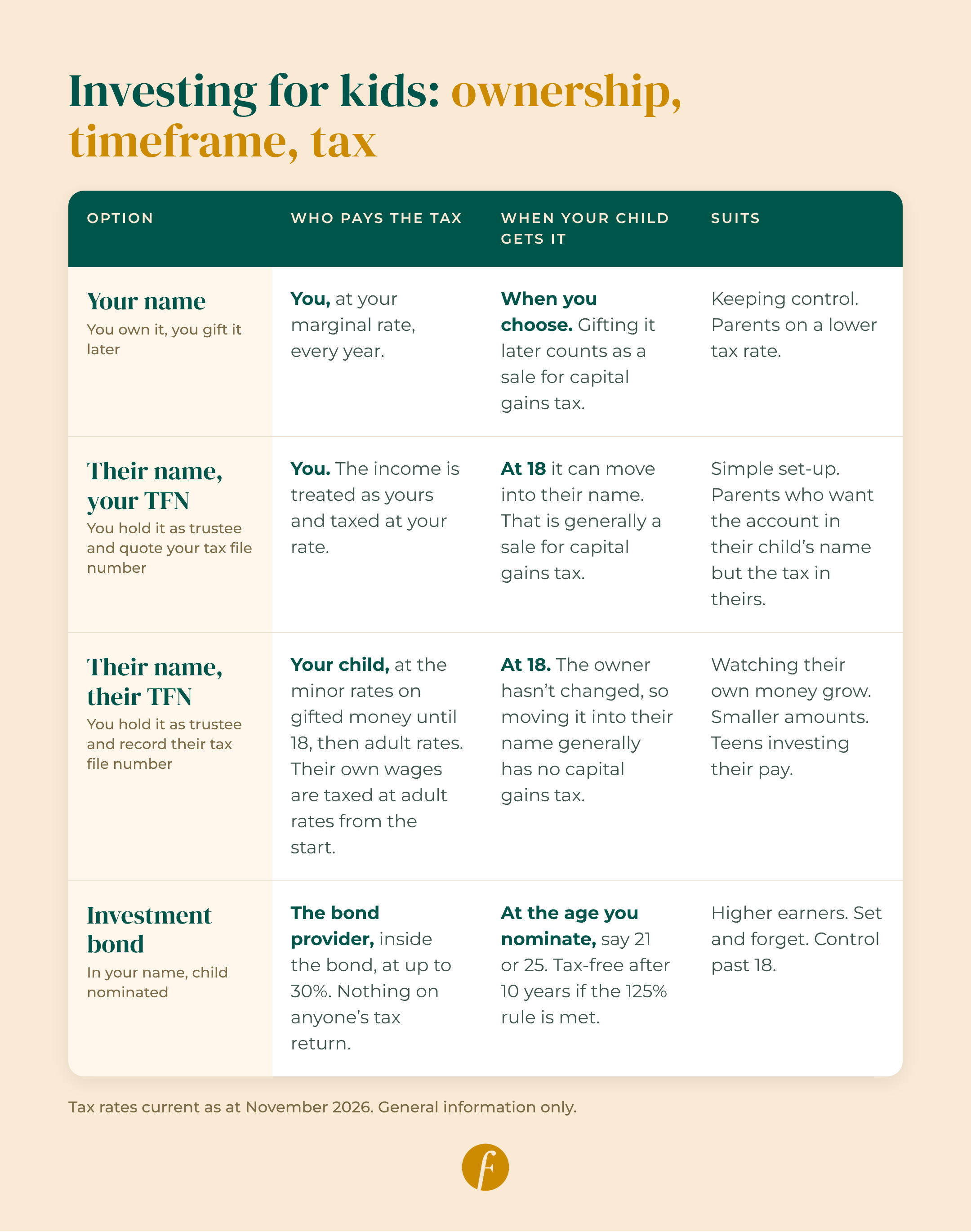
Your name. You open an ordinary account, you own it, and one day you gift it to your child. You keep full control over what’s bought, when it’s sold and when, or whether, it’s handed over. The trade-off: it’s your asset until then. It’s taxed at your rate, it sits in your estate, and gifting it later counts as a sale for capital gains tax, worked out on the market value at the time.
Their name, with you as trustee, using your tax file number. The account is opened for your child, you control it, and you quote your own TFN. The income is treated as yours and taxed at your rate. At 18 the account can be moved into their name, and that is generally a sale for capital gains tax purposes.
Their name, with you as trustee, using their tax file number. The account is opened for your child with their TFN recorded (children can get one at any age). The ATO looks at who provided the funds, who makes the decisions and who benefits, so keep records that show it was always your child’s. Income on money given to them is taxed at the minor rates until 18, then at adult rates. Their own wages, and what those wages earn, are taxed at adult rates from the start. Because the owner hasn’t changed, moving the account into their name at 18 generally doesn’t trigger capital gains tax.
An investment bond. The bond is in your name, but you nominate the age, say 21 or 25, when it transfers to your child. The provider pays tax inside the bond at up to 30%, so nothing goes on your return or theirs. You decide the handover date.
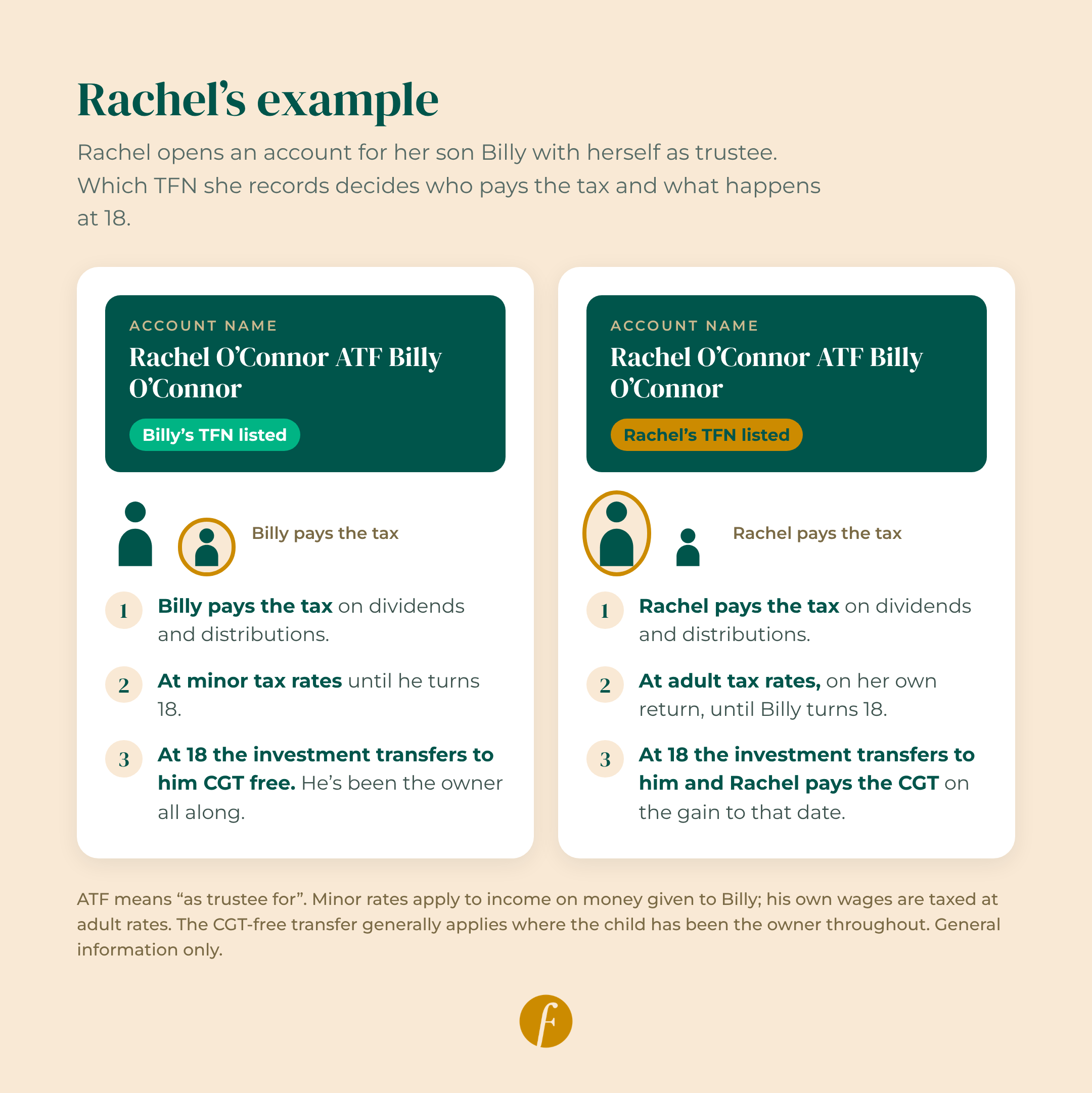
Who pays the tax?
The ATO taxes a child’s investment income (interest, dividends and distributions on money that was given to them) at special rates. For 2025–26:
The first $416 a year: no tax.
$417 to $1,307: 66% on every dollar over $416.
Over $1,307: 45% on the whole amount, not just the excess.
These rates exist to stop parents shifting investment income into their kids’ names to lower the family tax bill.
They don’t apply to money a child earns. Wages from a part-time job are taxed at ordinary adult rates with the normal tax-free threshold.
In the early years the $416 line rarely bites. A $5,000 portfolio paying 4% earns $200. But investments grow, and that’s the whole point. A portfolio paying $2,000 a year puts your 12-year-old in the 45% bracket on all of it. So the question isn’t whether tax will matter. It’s when.
Your name: you pay, at your marginal rate, every year.
Their name, your TFN: you pay, at your marginal rate, every year.
Their name, their TFN: your child pays, at the rates above, once gifted money earns more than $416 a year.
Investment bond: the provider pays, inside the bond, at up to 30%. Withdraw before 10 years and some of the earnings become taxable to you, with a credit for tax already paid.
When does my child get the money?
Your name: when you choose. Next year, at 25, or never, if plans change.
Their name, your TFN: at 18, and the transfer is generally a sale for capital gains tax.
Their name, their TFN: at 18, generally with no capital gains tax. The account moves into their name and they can do what they like with it. Most parents are fine with that for a modest balance. Fewer are fine with it for a large one.
Investment bond: at the age you nominate when you set it up, commonly somewhere between 18 and 25.
The “when” and the “who pays” are linked. Their name is simple now and hands over control at 18. Your name or a bond is a little more admin and keeps the timing yours.
At Flourix Wealth, we help women and families build financial confidence. If you’re ready to invest for your kids and want to get the structure right from day one, we’re here to help.
Here’s to your financial confidence,
Rachel
FAQs
-
Start with an amount you won’t miss and can keep up. $20 a week is over $1,000 a year before any growth. Set it up as an automatic transfer, and let birthday and Christmas money from grandparents go in too. Regular matters more than large.
-
Yes. There’s no minimum age. If you’re investing in their name with you as trustee, quoting their TFN keeps the income in their name and makes the handover at 18 cleaner.
-
Not yet. Brokers and investing apps require account holders to be 18. Until then a parent holds the account. At 18 it moves into your child’s name, and they can open accounts of their own.
-
If the shares are in your own name, yes. Transferring them is treated as a sale at market value.
-
No. Income a child earns from working is taxed at ordinary adult rates. The minor rates apply to investment income on money that was given to them.
-
The 10-year clock resets from the start of that year. Missing a year of contributions has the same effect. Decide on a contribution plan before you open one.
-
Some families with an existing trust ask about using it. Distributions to a child above $416 a year are taxed at the minor rates, and the Federal Budget has proposed a 30% minimum tax on income kept in discretionary trusts from 1 July 2028. It’s a conversation for your adviser and accountant together, not something to set up just to invest for the kids.
Sources and useful links References
Australian Taxation Office – Tax rates if you’re under 18 years old
Australian Taxation Office – Your income if you are under 18 years old
The information in this article is general advice only. It doesn't take into account your personal objectives, financial situation, or needs. Before making any financial decisions, you should consult a qualified financial adviser. Rachel O'Connor and Flourix Wealth Pty Ltd are authorised representatives of GPS Wealth Pty Ltd, AFSL 254544 | ABN 17 005 482 726.
Join The F Word Newsletter
Where we talk about the F words that actually matter:
Finance. Freedom. Future.
Made with ❤️ for women who don’t settle for the status quo.