
When Is Enough, Enough? How to find your number and stop moving the goalposts.
By Rachel O’Connor, Certified Financial Planner®
“How much do I need?” is the question I’m asked more than any other. How much to retire. To take a year off. To back a passion project. To drop to four days.
The answer always has two halves.
The numbers tell you what you can afford. The spreadsheet calculations.
Your values tell you what matters, what you're willing to trade and what you're not. The gut check.
Research backs this up. The Australian Unity Wellbeing Index, run with Deakin University, has found that financial stress hits wellbeing hard for households that can’t cover the basics.
But as Deakin researcher Dr Kate Lycett puts it, “Absolutely money matters up to a point. But once you’ve got those basics covered, the other things really come into play.” Relationships. Purpose. Time.
That’s the trap for high achievers. Past a certain point, more money no longer buys more life. And chasing it can start costing you the life you already have.
Why the goalposts keep moving
I see this pattern all the time with clients. Ambitious, successful women who hit every target, then quietly set a new one.
The bigger house. The next promotion. One more year of work. Success always feels a few steps away. And it stays a few steps away.
It’s like walking towards the horizon. You can walk all day, and it politely keeps its distance.
Psychologists call it the hedonic treadmill. We get used to each new level of income or lifestyle surprisingly fast, so the thrill fades and “normal” quietly resets higher. Financial planners have a less poetic name for the result: lifestyle creep.
None of this is a character flaw. We live in a world built on “more”.
Advertising’s whole job is to convince you something’s missing. Social media shows you everyone’s highlights and none of their credit card statements.
If you never decide where the finish line is, you’ll never know when you’ve crossed it.
The man who had enough
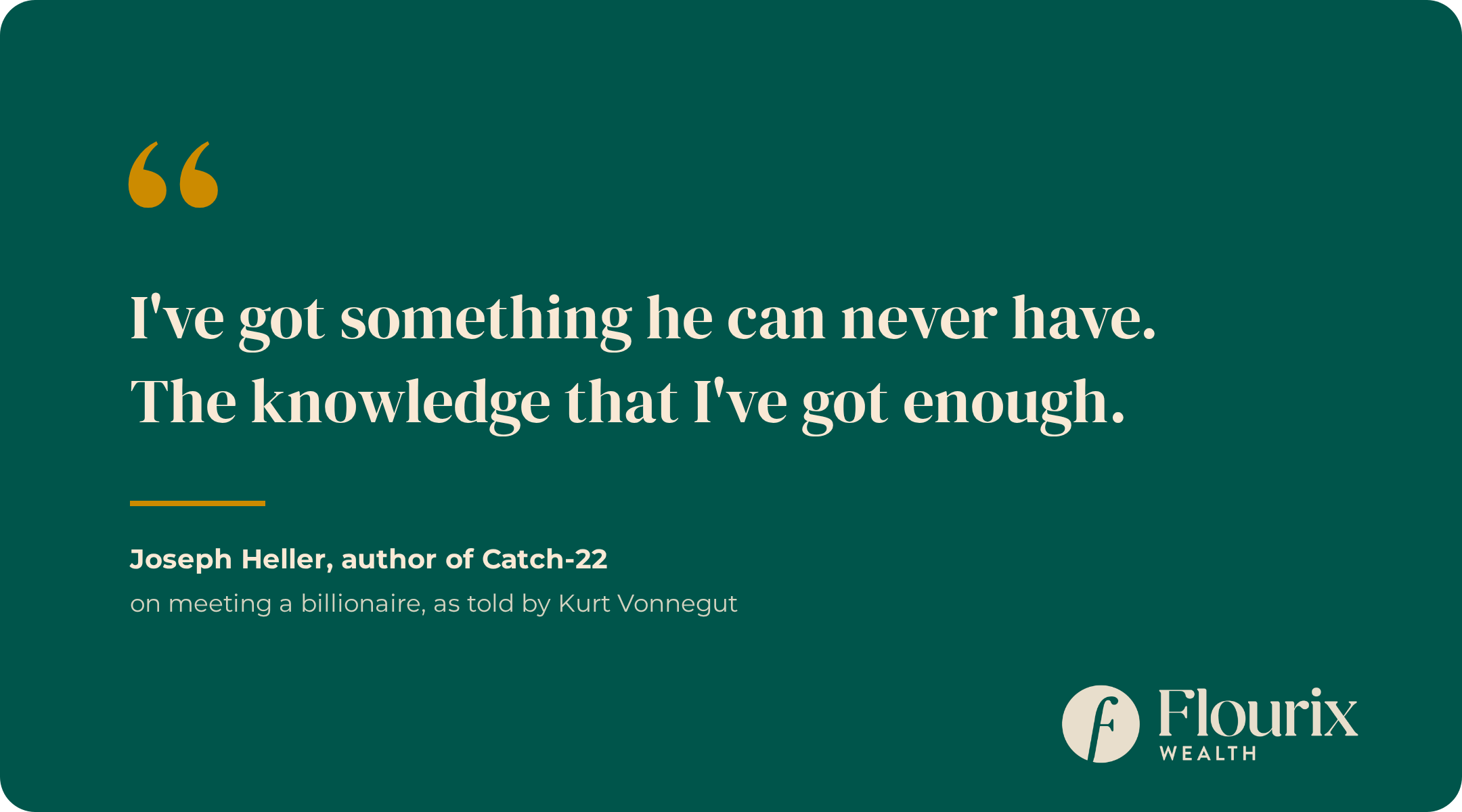
Novelist Kurt Vonnegut once wrote about being at a party thrown by a billionaire on Shelter Island, New York, with his friend and fellow writer Joseph Heller.
Vonnegut asked how it felt knowing their host may have made more money in a single day than Catch-22 had earned in its entire history.
Heller’s reply: “I’ve got something he can never have. The knowledge that I’ve got enough.”
Heller wasn’t saying money doesn’t matter. He was saying he knew what his money was for, and he’d reached it. That knowledge is worth more than any number on a statement.
Four ways to find your enough
Enough is personal. It has nothing to do with your neighbour, your colleague or the woman on Instagram.
Here’s a framework to figure out your enough.
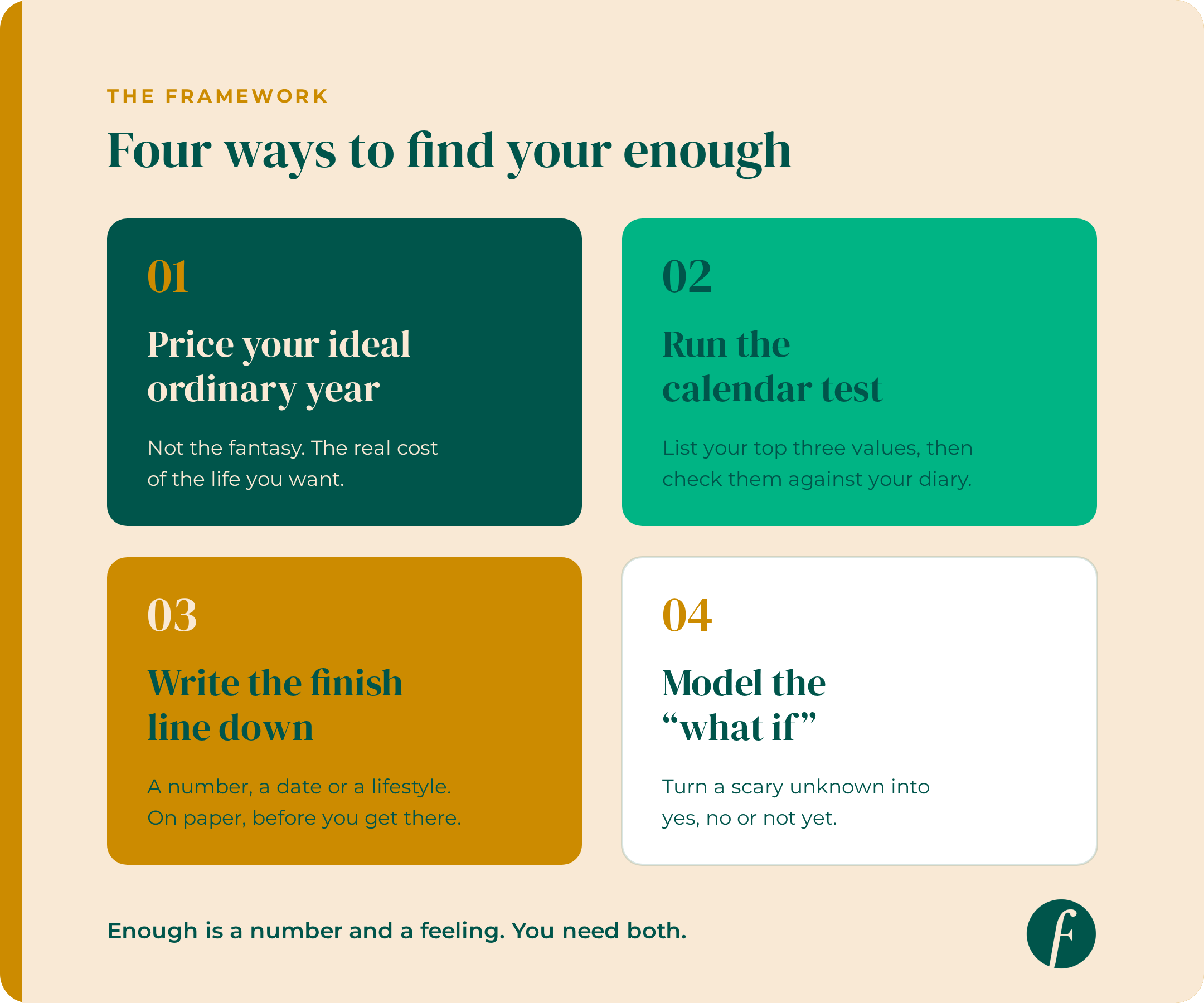
1. Price your ideal ordinary year
Not the fantasy year. A normal year of the life you want: your home, everyday living, health, travel, generosity and the fun stuff.
This single number does a lot of heavy lifting. It tells you how much income you need, how big your savings need to be, and whether the next pay rise changes anything at all.
Industry benchmarks are a useful starting point. The ASFA Retirement Standard puts a comfortable retirement for a single homeowner aged 65 to 84 at $56,166 a year, needing around $630,000 in super at 67 (June quarter 2026).
But benchmarks are averages of other people’s lives. Yours is the only number that counts. Some women need far less than the benchmark to live beautifully. Some need more.
2. Run the calendar test
Write down your top three values. Then open your diary and look at the last month.
Where the two match, you’re living your values. Where they don’t, “more” is costing you something.
When I did this myself, family was at the top of my list and nowhere near the top of my calendar. That gap told me more than any spreadsheet.
3. Write the finish line down before you get there
Goalposts move when they only live in your head. Put your finish line on paper: a number, a date, or a lifestyle.
“When my investments can cover $X a year, I’ll drop to three days.”
“When the mortgage is under $Y, I’ll stop saying yes to every project.”
Written down, it’s a promise to yourself. You’ll recognise it when you cross it, and you’ll be far less likely to quietly shift it.
4. Model the “what if”
Going to four days. Holding the business at its current size. Selling the investment property. Finally taking the long service leave.
Whatever your “what if” is, running the long-term numbers turns a scary unknown into a clear yes, no or not yet. Most women I work with are in a better position than they think. Some have catching up to do. Either way, you stop guessing.
For a head start, the government’s Moneysmart retirement planner is a good free tool for a first look at your numbers.
Not sure where to start? See a completed example.
When you have enough but can’t feel it
Sometimes the problem runs the other way.
One of my loveliest clients inherited money unexpectedly, just as she was finishing up her career. Without it, she would likely have relied on part-time work and the Age Pension for years.
On paper, she suddenly had enough. It didn’t feel like it. She was deeply grateful and determined not to waste it, so for the first few years she barely touched it. It didn’t feel like hers to spend.
We built a plan around her values. Ethically invested, a conservative mix she was comfortable with, and a clear amount she could safely spend each year.
Slowly, things shifted. A reliable car. Then a new bathroom, not just patching the plumbing. Holidays that started local and have grown into a few weeks in Europe. The strategy has quietly done exactly what we designed it to do, and every year she gets a little more comfortable enjoying it.
Knowing your enough isn’t only about when to stop chasing. It’s also about giving yourself permission to live.
Your enough, your call
Enough is your calculation and your decision. Nobody else gets a vote.
And once you know your number, something shifts. The chasing stops. The guilt about spending eases. You finally get to enjoy what you’ve built.
At Flourix Wealth, we specialise in helping women take charge of their financial lives.
Here’s to your financial confidence,
Rachel
FAQs
-
According to ASFA, a single homeowner needs around $630,000 in super at 67 for a comfortable retirement, and a couple around $730,000 (June quarter 2026). These figures assume you own your home and receive a part Age Pension. Your own number depends on how you want to live, whether you rent, and what you want to leave behind, so treat benchmarks as a starting point.
-
You have enough when your money can reliably fund the life you want, including a buffer for surprises, and extra money wouldn’t meaningfully change how you live. The simplest test is to price your ideal ordinary year, then check whether your income, savings and investments can sustain it long term. A financial planner can model this for you.
-
Lifestyle creep is when your spending quietly rises every time your income does. A pay rise becomes a nicer car, a bigger home or more expensive holidays, so you never feel further ahead. It’s driven by the hedonic treadmill, where we adapt to each new level of comfort quickly. Deciding your “enough” in advance is one of the best defences.
-
Usually because the goalposts keep moving. Without a clearly defined target, each achievement simply resets the bar higher, and comparison with others makes it worse. Many women who feel behind are in a better position than they think. Writing down a specific finish line, and checking your progress against it, helps replace the feeling with facts.
-
Yes, if the numbers and your values both say so. Stepping back from the next promotion can be a smart financial decision when your current income already covers your ideal life and future goals. The key is modelling the long-term impact on super, savings and retirement first, so you’re choosing with confidence rather than guessing.
-
It depends on your spending, savings, debts and how long you plan to work. The best way to find out is to model it: compare your current path with a four-day or three-day week and look at the impact on cash flow and retirement. Many women find a modest cut in income costs far less than they expected.
-
A financial planner turns “how much do I need?” into a clear, tested number. They’ll help you price your lifestyle, model different scenarios over decades, factor in super, tax and the Age Pension, and show you the trade-offs. At Flourix Wealth, we also help you align the plan with your values, so the number feels right.
Sources and useful links References
Australian Unity Wellbeing Index, how income affects wellbeing
Kurt Vonnegut, “Joe Heller”, The New Yorker, May 2005, via The Marginalian
The information in this article is general advice only. It doesn't take into account your personal objectives, financial situation, or needs. Before making any financial decisions, you should consult a qualified financial adviser. Rachel O'Connor and Flourix Wealth Pty Ltd are authorised representatives of GPS Wealth Pty Ltd, AFSL 254544 | ABN 17 005 482 726.
Join The F Word Newsletter
Where we talk about the F words that actually matter:
Finance. Freedom. Future.
Made with ❤️ for women who don’t settle for the status quo.